2.11.2011

tour di Roma! part one

 Hey ya'll,
   I know it's been awhile since I last updated, but I'm about to make it up to ya'll. I'm updating today/tonight about our trips into Rome the past few days. We've all been super busy with Experts of the Day and our Scavenger Hunt. Below are all the places we visited on our first day into Rome. The second update will be our second day in Rome, and the thrid update will be today's Scavenger Hunt and what I have to say about it all. Thanks for reading!


{Capuchin Crypt}
Capuchin Crypt...yep that's all bones.
  • The Capuchin Crypt is a small space comprising several tiny chapels located beneath the church of Santa Maria della Concezione dei Cappuccini.
  • It contains the skeletal remains of 4,000 bodies believed to be Capuchin friars buried by their order.
  • When the monks arrived at the church in 1631, they brought 300 cartloads of deceased friars. Fr. Michael of Bergamo oversaw the arrangement of the bones in the burial crypt.
  • Bodies had to be buried typically 30 years before they could be dug up.
  • There are six total rooms in the crypt, five featuring a unique display of human bones believed to have been taken from the bodies of friars who had died between 1528 and 1870.
  • Crypt of the Resurrection, featuring a picture of Jesus raising Lazarus from the dead, framed by various parts of the human skeleton. The key to interpreting the crypt's displays of funereal art lies in the Christian belief in the Resurrection of the body and everlasting life.
  • The Mass Chapel, as an area used to celebrate Mass, does not contain bones. The chapel contains a plaque with the acronym DOM, which stands for Deo Optimo Maximo ("To God, the Best and Greatest"), a term initially used to refer to the pagan god Jupiter but claimed by later Christians. The plaque contains the actual heart of Maria Felice Peretti, the grand-niece of Pope Sixtus V and a supporter of the Capuchin order.
  • Crypt of the Pelvises.
  • Crypt of the Leg Bones and Thigh Bones.
  • Crypt of the Three Skeletons each soul resembles something and the plaque in the middle says What you are now we used to be; what we are now you will be..."
(via Elizabeth Verdone)


Mouth of Truth
{Bocca della Verità}
[the mouth of truth]

  • Carved from Pavonazzetto marble.
  • Takes the shape of a man.
  • Known to be a lie detector in ancient times, now just a tourist spot for many to come take pictures with.
  • Thought to be part of an ancient Roman fountain or a drain cover.
  • Represents various gods such as Oceanus in particular.
  • From the middle ages, if someone told a lie and put their hand in the mouth it would be bitten off “they say”.
  • It has appeared in many films such as Audrey Hepburns Roman Holiday.
  • There are many replicas some of which are in California, Paris and many electric coin operators at various train stations.
  • Been in the church since 1632.
  • The legend is from a Roman noble who thought his wife was cheating on him.
  • He made her stick her hand in the mouth and before she did a man came out of the crowd and kissed her.  It was a trick because she knew that she hadn’t lied because she announced the only man she has ever kissed is her husband and this man from the street who was her actual lover.
  • Her hand was not bitten off and so now it does not carry out the function of a lie detector just a tourist attraction!
(via Alex McCall)

Jewish Ghetto
{Jewish Ghetto}


  • The (Roman) Jewish Ghetto in Italia, Ghetto di Roma, was located in the Rione Sant'Angelo.
  • Papal Bull, a proclamation and rule issued by the Pope Paul IV in 1555 segregated the Jews in a walled quarter with three gates that were locked at night, and subjected them to restrictions on their personal, professional and religious freedoms.
  • The measures that were included in these Papal restrictions, were implemented solely to segregate the Jews from the Christain majority of the population with space and laws.
  • Many Jews were led to believe that the restrictions were made to protect the Jews and their beliefs from Christain mobs that were sent to harm them.
  • In the revolution 1848, the Ghetto was abolished temporarily.
  • Jews petitioned for permission to live there, and were disabled from owning any property even in the Ghetto, and in turn had to swear yearly loyalty to the Pope by the Arch of  Titus.
  • The requirement that Jews live within the Ghetto was abolished when the last remnant of the Papal states was overthrown on September 20, 1870.
  • Rome tore down the Ghetto's walls in 1888 and demolished it almost completely, before the area was reconstructed around the new Synagogue of Rome.
  • The ghetto of Rome was the last remaining ghetto in Western Europe until its later reintroduction by Nazi Germany.
  • Now the Jewish Ghetto is one of Rome's most charming, up and coming neighborhoods, with restaurants serving up some of the best food in the city. (Friend Artichokes!)  There is one remaining piece of the Ghetto wall, which was built into the wall of one of the courtyards off the Piazza delle Cinque Scuole.
(via Sallie Robbins)


The whole group on Tiber Island
{Tiber Island}
  • The Tiber Island or The Isola Tiberina  is an island in the middle of the Tiber River which runs through Rome.
  • It is one of two islands in the Tiber River, the other is located near the mouth of the river.
  • The island is linked to the rest of Rome by two bridges, one on each side.
  • It was once called Insula Inter-Duos-Pontes which means "the island between the two bridges"
  • Tiber Island has long been associated with healing.
  • Tiber Island was once the location of an ancient temple to Aesculapius, the Greek god of medicine and healing.
  • According to the legend, it was created from the accumulation of mud over the crops that the Romans threw into the river after they had driven Tarquin the Proud, the last king of Rome. 
  • Because of its association with medicine, Fatebenefratelli hospital is located on the island.
  • In 294 B.C. a plague hit Rome and the island became a place of refuge for those who didn't want to catch it. 
  • The Roman Senate as instructed to build a temple so the delegation set sail to Epidauros get the statue of the deity. The delegation put a snake on board and it climbed the ship's mast. When they got back to Rome the snake is said to have gone into the river so the temple was built there. 
  • The island is boat shaped because it became so closely associated with that story.
  • The island is 270 meters long and 67 meters wide.
  • The Ponte Fabricio is the only original bridge in Rome.
(via Katie Whitehurst)


{Trastevere}
Cafe in Trastevere
  • Trastevere is the XIII district of Rome, on the west bank of the Tiber, south of Vatican City.
  • It’s name comes from the Latin Trans Tiberim, meaning "beyond the Tiber"
  • Its logo is a golden head of a lion on a red background, but the meaning is uncertain.
  • Trastervere is separated from Rome by the river.
  • Trastevere has many narrow cobbled streets lined with medieval houses.
  • Trastevere is well known for its nightlife, rich in clubs, pubs, and restaurants.
  • The Piazza Santa Maria is the most popular gathering spot, it’s nicknamed the “Piazza that never sleeps”
  • They often have street performers entertain crowds with music, fire juggling, acrobatics and comic skits, late into the night.
  • Basilica Santa Maria is also on the square and is one of the oldest churches in the area.
  • There are 2 American Universities in the area.
(via Brittany Sims)


Piazza Di S.Maria in Trastevere

{Castel Sant’Angelo}
One Statue depicting a Sign of Jesus' Crucifixion
  • Also known as the Mausoleum of Hadrian.
  • A monument of Rome.
  • connected to the Vatican through a fortified corridor of the "small step".
  • The castle has been radically changed many times in medieval and renaissance on the right bank.
  • Completed by Antonius Pius in 139.
  • It was initially commissioned by the Roman Emperor Hadrian as a mausoleum for himself and his family.
  • The building was later used by the popes as a fortress and castle, and is now a museum.
  • The tomb of the Roman emperor Hadrian, also called Hadrian's mole,[1] was erected on the right bank of the Tiber.
  • Hadrian's ashes were placed here a year after his death in Baiae in 138 AD, together with those of his wife Sabina, and his first adopted son, Lucius Aelius, who also died in 138 AD.
  • Following this, the remains of succeeding emperors were also placed here, the last recorded deposition being Caracalla in 217 AD.
  • Much of the tomb contents and decoration has been lost since the building's conversion into a military fortress in 401.
  • The popes converted the structure into a castle, from the 14th century; Pope Nicholas III connected the castle to St. Peter's Basilica by a covered fortified corridor called the Passetto di Borgo.
  • The fortress was the refuge of Pope Clement VII from the siege of Charles V's Landsknechte during the Sack of Rome (1527).
  • The Papal state also used Sant'Angelo as a prison.
  • Decommissioned in 1901, the castle is now a museum.
(via Rachel Simitherman)

Castel Sant'Angelo


{St. Peter's Crypt}
[vatican]
Vatican
  • Located under St. Peter's Basilica that includes several graves and a structure that may have been built to memorialize the location of St. Peter's grave.
  • Near the west end of a complex of mausoleums that date between about AD 130 and AD 300. 
  • The complex was partially torn down and filled with earth to provide a foundation for the building of the first St. Peter's Basilica during the reign of Constantine I.
  • Many bones have been found at the site of the 2nd-century shrine, as a result, two archaeological excavations began. Pope Pius XII started in December 1950 that none could be confirmed to be Saint Peter's with absolute certainty.
  • Following the discovery of further bones, on June 26, 1968 Pope Paul VI announced that the relics of St. Peter had been discovered.
  • St. Peter’s grave lies at the foot of the aedicula beneath the floor.
  • Many of the popes of the Catholic Church are entombed at St. Peter's Basilica. Some of the tombs are up on the main level of the church.
  • St. Peter, the first pope, is located in the crypt or Sacred Grottoes, one floor below.
  • The crypt has long been a place of pilgrimage for the faithful, but after John Paul II was entombed there in 2005, visitation increased enormously
  • The Red Wall, behind St. Peter, early Christian pilgrims scratched prayers, invocations, thanks, or simply their names in Latin. Behind this wall they found a small pocket of a tomb and a box filled with bones that doctrine now holds once belonged to St. Peter. 
(via Me)

Fountain in St. Peter's Square

{Knights of Malta Keyhole}

Knights of Malta Keyhole
  • The Keyhole is located on the wooden doors of Piazza dei Cavalieri di Malta.
  • It is known affectionately by the Romans as the "hole of Rome".
  • If you look through the keyhole, you get a perfect view of St. Peter's Dome. It is the key to the garden which is part of a structured design. The bushes on the garden path fan the dome. 
  • Originally, the area was a fortified palace belonging to Alberico II.
  • In 939, it became a Benedictine monastery.
  • At the end of the 1600's, Cardinal Benedict Pamphilj transformed the area into a coffee house.
  • In 1765, the famous architect Giovanni Battista Piranesi restored the building. 
  • It became the retreat for the Knights of Malta.
  • The Knights of Malta were on e of the last surviving orders from the crusade.
  • The headquarters of the knights are now in Rome and they are considered to be one of the three nations of Italy. 
(via Leah Rainold)


{Other Places in Rome}
Great interior design shop!
teatro di marcello
Some of us on Tiber Island

to be continued....

2.08.2011

Expert of the Day

  • it may seem we're on a big vacation over here but i promise we do have homework & we do learn things!


{Expert of the Day}
       :During the course of the semester, we will be traveling to many different destinations to learn about the art, design, history, culture, politics, and mores of Italy and the Italian people. Prior to several of these excursions, we are assigned a specific site, cultural topic, person, current event, etc. and have to prepare a 5 minute talk and a concise one- page handout for each of our peers that is relevant to the study abroad experience. 
{facts about the towns in the Castille Romani}

 :Ariccia
-Auburn's only international campus is located in Ariccia.
-Bernini was inspired by the restoration of the Panthenon when creating the dome at the church of Assunta.
-Ariccia is located in "Parco Regionale dei Castelli Romani"
-Porchetta is pork roasted with herbs and wild fennel. (Ariccia is famous for this)
-Ariccia is located in the Lazio region.
-The population is around 19,000.
-In 1854 Ariccia and Albano were connected by the bridge.
-Ariccia stands over a crater of an extinct volcano.
-The palace belonged to the family until 1988.
-Pope Alexander VII is associated with development of Ariccia. 
-Ariccia is near the cities of Albano, Castel Gandolfo and Genzano. 
-Ruins were found from the 8th and 9th centuries B.C. 
(via Mary Whitehurst)

:Albano
-a comune in the province of Rome, on the Alban Hills, in Latium, central Italy.
-Catacombs of San Senatore; originally quarries on the Appian Way, became the 2nd century burial place of Christians.
-Terme di Cellomaio; attributed to Emperor Caracalla, who had erected immediately after killing his brother Geta as a gift to appease the souls of the soldiers. Inside a picturesque medieval village, with the Church of San Pietro. During the Middle Ages, until the modern age, it was believed they were the remains of a fabulous palace of Ascanio. The old building was transformed into a stronghold in medieval times and later occupied by civilians.
-Park- Above all, the historic center features is the presence of vast green area of the park of Villa Doria Pamphili, and the pine forest of Colle dei Cappuccini. Really fun place to maybe see. Very pretty pictures of the park.
-Really pretty church is The facade of the church of Santa Maria della Stella.
-The predominance of the vowel "or" against "u" that characterizes most dialects spoken in the surrounding towns differs with Albanense.
-One of the 12 most populated cities in Rome.
-Albano's economy is historically linked to wine production, active primary importance in an area such as the Alban Hills known for its wines since Roman times as the Castelli name of Albanum. Also has a huge market for vegetables.
-Has a soccer team. Colors are blue and white.
-Called the Alba Longa.
-Antique market: the second Sunday of each month.
-The Alban Hills (Italian Colli Albani) are the site of a quiescent volcanic complex in Italy, located 20 km (12 mi) southeast of Rome and about 24 kilometres (15 mi) north of Anzio.Sometime the carbon dioxide given off by the hills is lethal and in 2001 eight sheep where killed because of it.-Said to have had great vineyards.
(via Elizabeth Verdone)

:Abazia di San Nilo in Grottaferrata
-It is one of the most internationally known holy places in the Castelli Romani.
-It was founded in the year 1004 by Saint Nilo and Saint Bartholomew, fifty years before the schism between the Catholic Church and the Orthodox Church.
-The Abbey was built on the remains of an ancient roman villa, which is believed to have belonged to famous roman orator Cicerone.
-The Abbey is now of Byzantine rite, under the authority of the Holy See.
-Abbot Nilo da Rossano built the monastery in the same place were he had an apparition on the Holy Mary.
-Abbot Nilo da Rossano died the year after moving to Grottaferrata and did not oversee the completion of the abbey.
-It was completed under the supervision of St. Bartholomew.
-The facade, with its rose window, has being restored to its original shape. The facade also has small, gothic arches.
-The hallway, composed of travertine column, was restored in 1930, while the interior, originally in Romanic style, was turned into Baroque in 1754, by means of plaster covering which encases the frescoes and the columns.
-The triumphal arch separates the center of the church and is decorated with medieval fresco representing the Pentecost.
-The mosaics portray the Twelve Apostles sitting beside an empty throne, evoking Christ's ascent to Heaven.
-There is a library in the abbey containing Greek and Latin books and is considered to be one of the most complete libraries worldwide containing over 50,000 volumes.
(via Leah Rainold)

:Frascati
-A southern Italian town located in the Lazio region, Frascati lies 20 kms south of Rome in the Alban Hills and is famous for its beautiful villas, scientific developments, and white wine. Rich in art, literature, and music, Frascati remains an artistic center for prestigious individuals that have been residing in Frascati for hundreds of years.
- Dating back to Ancient Roman times,  Frascati was known to be a feudal possession to the condottiero Marcantonio I Colonna from Pope Julius II.
-Frascati housed the first railway to be built in the regions of Rome.
-Frascati is famous for its villas that were built from the 16th century on as status symbols of the aristocrats of Rome. Popes, cardinals, and nobles designed and lived in these villas using them for social activities.  
- Nonni designed the Cathedral of Frascati known as the Cathedral Basilica of St. Peter Apostle, and the Bishop’s Palace (the old Rocca) is a large Palace where the Bishop of Frascati resides. 
- Known for its symbol and cookies of the three breasted woman.
-A major site to visit is the Villa Falconieri.
The villa was originally called Villa Rufina, having been was initially built by Monsignor Alessandro Rufini. Later it was enlarged thanks to Pope Paul III, and dates back to 1546. It is famous for its royal visits and its modern use as the headquarters of the Centro Europeo dell' Educazion.
-“The Science Town”
-Frascati hosts multiple scientific laboratories that are responsible for missions in the European Space Agency, research facilities of the National Italian Agency of new technologies, and the Spaceguard Foundation.
-In the month of February Frascati hosts a festival called Carnevale, a huge festival with parades and celebrations.
-Festa dei SS Filippo e Giacomo, a famous festival held in May in honour of the town's patron saints.
(via Sallie Robbins)

:Castelgandolfo
-15 miles southeast of roma.
-Summer residence of the pope.
-Seventeenth century housed Olympics: staged rowing events during Roma Olympics.
-Castel Gandolfo is derived from the Latin Castrun Gandulpho , because it was presumably owned by the family of Gandolfi , originally from Genoa.
-It is the home of the famous Alba Longo, the capital of the mythological Latin League, a city founded by Asccaniun, the son of Aenes.
-Pope clement VIII included the castle in the list of the holy goods that could not be sold in 1596.
-In 1870 Pope Pius IX was the last pope to put foot in Catel Gandolfo until 1929. In 1933 the Vatican Observatory as moved from Roma to Castel Gandolfo because of too much artificial light. Then in 2008 that due to deterioration in Castelli Romani it would be again moved to the USA.
-The parish church dedicated to St. Thomas of Vilanova was designed by Bernini on the order of Chigi Pope Alexander VII.
-It was the pope’s summer residence in the seventeenth century.
-Vill Chigi, built by Cardinal Flavio Chigi, nephew of Pope Alexander VII, is today home to a golf course.
-Villa of Pubius Clodius Pulcher is the remain of the Roman villa located on the Appian Way.
-The restaurant “Pagnaelli” has been operational since 1882. GO HERE! GREAT FOOD!
-This city was portrayed in Assasins Creed The Brotherhood
-Notable wines: Frascti, the Marino, the Velletri and the Colli Lauvini.
-Since 1960(the Olympics) Lake Albano has been used as a Canoe/Kayak site.
-The clock on the castle is split into six sections following the Italian time counting system. 
-The fountain in the square was designed by Bernini.
-There is a full coat of Papal arms on everything because it is the summer home for the popes.
(via Rachael Smitherman)

  • That was all our expert of the days for our Field Trips last week. Be ready to learn about Rome and all it's popular sites coming this week!
Ciao.

2.07.2011

:the start of {week 2}

Buongiorno, come va? (Hello, how are you?)
    Today was our first conversational Italian class with Ms. Corinna Torregiani. We learned basic phrases and words that we'll use in greetings, ordering at the market and deli, as well as the "to be"verb. By the time I get the hang of this language I'll probably be sitting in my seat to fly back to the states in April, but I feel like I'm picking up what I need to know pretty fast.
    Before our first class we went to the Ariccia market. The locals literally had everything to buy, from candy to bras, vegetables to hair bands. We also finished touring the Cardinal Rooms of the Palace. My favorite part of the day was a cooking lesson with Prof. Mary Lou Grey. Mary Lou is originally from Scotland, moved to South Africa, and now is married to Marco (another professor), who grew up in Switzerland but was born a Roman. Mary Lou showed us how to make a basic tomato sauce with onions, white wine, and bacon, as well as, a sauce without bacon (that's the one I had). Bacon over here isn't what you think of, not like the one we buy in the United States. Needless to say, it was amazing and filling. Mary Lou said over here Italians rarely eat pasta for dinner because it's to heavy on the stomach, since they don't eat dinner before 7:30 or 8 at night. Usually dinners consist of their proteins and vegetables.
    I hate to admit it but after we had our break for lunch we watched a movie on architecture in Rome and the second I sat down I fell asleep for almost 2hrs. I thought my sleeping schedule was back on track but that afternoon nap just makes me feel a lot better...I wasn't the only one. Tomorrow is another day of classes, Roman Architecture, "History of civiliation of the Mediterranean", "History of Philospohy and Mythology", and an introduction to the South: "The Italian social structure, the southern case." I'm not one to sit all day in a classroom, but Wednesday thru Sunday we get to go to Roma!
Fromal wear of a Chigi Prince

Formal Wear of a Chigi Princess
(love this one!)

Mary Lou cooking Tomato Sauce

Homemade Lunch, Molto Bene!

Allora io vado, buonasera a tutti! (I'm off, goodnight everyone.)

2.06.2011

A Saturday in Roma

Ciao!
Saturday in Italy for me consisted of going to a walk through Genzano, browsing around Ariccia's Saturday market, and having dinner and gelato in Roma while getting an introduction to the famous Trevi fountain and Spanish steps. I've familiaritized myself with the train from Albano to Roma and the metro I think I can do this on my own if I have to. I'm the kind of person who picks up on directions pretty fast, which comes in handy when you're in a completely different country with signs in Italian. I'm also trying to learn the basics of the lauguage. I make my grocery lists in both Italian and English just incase I have to ask where something is or order something from someone...like turkey or cheese. 
This week we're spending a lot of time in Rome. We have a big assignment this week...Rome Scavenger Hunt. Basically, answer a question with something found in Rome, fine your way there, and take a picture...I'll post that on here as well. Below are some pictures of my Saturday...enjoy!


Road to Genzano 

Ariccia Market: Goggles
Ariccia Market: Binoculars 
Brittany, Laura, Me, Laurie on Train to Rome
First view of Rome 
White: Dinner in Rome (i love the place setting!) 
Trevi Fountain
Trevi Fountain
Spanish Steps: Brittany and I
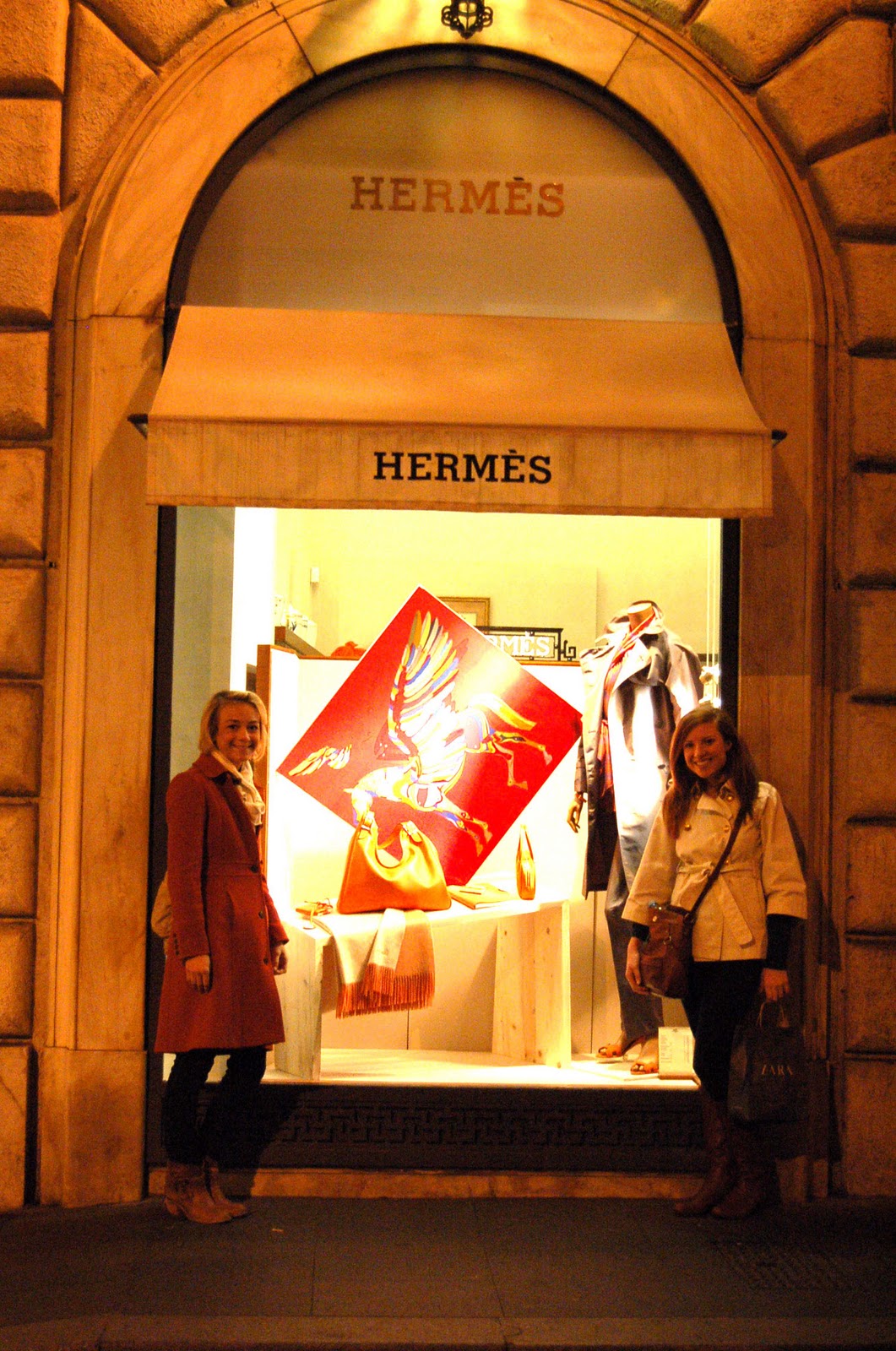
Memories of Lighting Final: Hermes Store
Me and Susanna
(this one is for you Melanie)

2.05.2011

Into to Roma

A little introduction to Roma

The link above is to my photo page. I posted a quick introduction to Roma and a few more to Ariccia and Genzano as well. I'll update tomorrow (Sunday). Rome is amazing! You could spend weeks there and not see everything, luckily I'll be here awhile!

Ciao,
Jamie

2.03.2011

Castelli Romani

Interior Design Girls
Ciao! Day Two & Three 
This might be a long one...
Nook Wall (my room)
Nook 


I'm still trying to get used to this sleeping schedule over here. I go to bed late, 1am at least, wake up a few times during the night, and eventually wake up around 8am to the ring of alarm clocks. But hell, I'm an interior design major I'm used to this stuff, it doesn't stop me from having the most amazing time of my life. To be honest when everyone said they didn't want to leave, that this trip was the time of their life, I said to myself, "Yeah, I'm sure its amazing but never want to go back to the United States? I don't know about that." But! I've been here three days and I'm in love!!!! I really don't want to go back, how about everyone just move over here?! I'm really having the time of my life and made one of the best decisions of my life. I've never been so blessed, fortunate, and lucky to be here right now. It's almost to hard to understand if you come here and just experience it. I think what really hits me about everywhere that I've gone in the past two days is the way of life. Everything is slowed down, people really take the time and embrace life and the beauty around them. Everything and everyone is so simple, so friendly. Oh America, how you have so much to learn from this place. 
Rock in the Chigi Palace Garden (look closely!)
Chigi Palace Gardens
Yesterday was packed full of stuff to do. We started the day at the Palace with an orientation to the classes, assignments, and trips we're covering over the next 12 weeks. Lunch was more of a trip planning frenzy! Barcelona, Paris, and Greece are official starting in two weeks with Greece. Switzerland, Germany, and Prague are still in the planning process. Who knows the next time I'll be able to do this so I might as well do as much as I can while I'm here. Lunch was followed by an introduction to the Chigi Palace and pictures in the gardens. I also had my first adventure to the grocery store. I really did fine until I had to order turkey at the deli. I took pre packaged turkey with me and pointed to the word as I murdered the pronunciation, but was okay until he asked how much. How much? I don't know a kg is too much so I knew I wasn't going to get off easy. After a lot signing and laughing at myself he understood to stop when I put my hand up. Sliced cheese, not so much, deli's in Italy don't do that, but not knowing that and trying to explain what I wanted was another, "dumb American" moment (got to laugh at myself, no embarrassing moments in Italy just adventures). For dinner we went for pasta in Albano, just across the bridge next to the Palace. Needless to say the best tomato basil pasta and salad of my life. If I didn't learn to like tomatoes before I came to Italy I definitely would have learned here. I've gotten to the point where I just want to eat them like grapes or potato chips. You don't want to stop eating until you're about to fall over, but that's one thing I've learned over here...you need to stop or you will be miserable. 
Church in Frascati
Today we took our first field trip, a tour of the Castelli Romani, made up of the towns of Frascati, Nemi, Genzano, Albano, Ariccia, and  Montecavo. We started at the top of the mountain behind Ariccia in Montecavo, and slowly made our way down the mountains through the towns. Every one so close together, but so different. I officially had my first Italian cappuccino in Frascati, why do I drink coffee if I could drink that amazing goodness? We had lunch overlooking Lake Nemi. (Fun Fact: Nemi famous for strawberries) I packed lunch to save some money but ended up sampling fettuccine and tortellini anyway, YUM! Our last stop on our Castelli Romani tour was the summer home of the Pope, Castel Gangolfo. Frascati was by far my favorite. Some of us want to get lunch or dinner there one day just to go back and walk around more because it was the perfect little town. 
Three boob cookie(Frascati) .& Brittany
We returned to the Palace around 4:30. The past 5 hours have been packed with picture editing, uploading, blog updating, and emailing. Next to actually being here is being able to share my excitement and adventures with all of you! If anyone has suggestions for places to see, stay, eat, and things to do in Barcelona, Paris, Athens, Prague, Berlin, and Switzerland, please, please comment below and let me know! Or if there's any other places in Europe that should be on my list of things to see. 

I love you all, wish you were here!
Jamie


Roma Roommates (fountain in Frascati)
Tomato and Basil Pasta 
Cappucino in Frascati
Tortellini in Nemi
Look mom, polish stuff!


Genzano

Nemi

Mushroom Shop in Nemi


@ the Castel Gangolfo (pope's summer home)
This is for you mom..leopard fur w/matching bag!


Look at all my pictures: Italy Photos

2.01.2011

4787miles or 7660kilometers

Street Sign going into Ariccia
Ciao!
View from the bridge outside the Palace.
          After a 9 hour flight, 4787 miles, and accepting the fact ice really isn't anywhere to be found over here, I have arrived in Ariccia! Out flight was delayed about an hour leaving Atlanta yesterday afternoon, but once in air I took a few NyQuil and said goodnight for at least 2/3 of the flight. Flying over wasn't what I thought it would have been. After going to Ireland and Scotland on two huge planes with at least 12 plus people across, this flight made me feel like I was on a "puddle jumper" going over the atlantic ocean. I luckily didn't get a middle seat but didn't get a window either. I thought I was going to be more nervous than I was too. It's been awhile since I took that long of a flight but I think the excitement of me finally being in Italy outweighed any fears I had about getting over there (or here I should say...).
They might have gone bankrupt in the
U.S. but still going strong in Italy! 
         Once we arrived, unpacked, and learned a few housekeeping rules, we had lunch. Then we took our first tour of Ariccia and Albano, the neighboring town. Every store is closed here from 1pm-4:30pm for lunch (bet ya'll wish you could have a lunch break like that in America). Everything is in Italian but I feel like I'm going to pick up on what signs mean very quickly. The few American things I did discover were a Blockbuster, Michelin Tire, and a Shell gas station, random? yes. Oh and I can't forget to tell you the first restaurant I saw after leaving the airport was a McDonald's (go figure).
     We learned how to buy bus and train tickets and where to pick them up and where to get off. Where the various grocery stores, outdoor markets, cafes, pharmacies, and atm's available to us are. After we had a few hours to relax we had dinner at a pizzaria down the street. We tried tons of smoked meats, cheese, bruchetta, and pizzas all topped off with my favorite...dessert. (picture opportunity missed...forgot my memory card to my camera in my computer, i'll just relive it again one night).
Not going too picture crazy at this point (the first day) but I think it's about to start...


"When in Rome!" ( or Albano)